India–Sri Lanka FTA TRQ (Import Quota): Notifications, Quota Limits & How to Use the Benefit
February 13, 2026
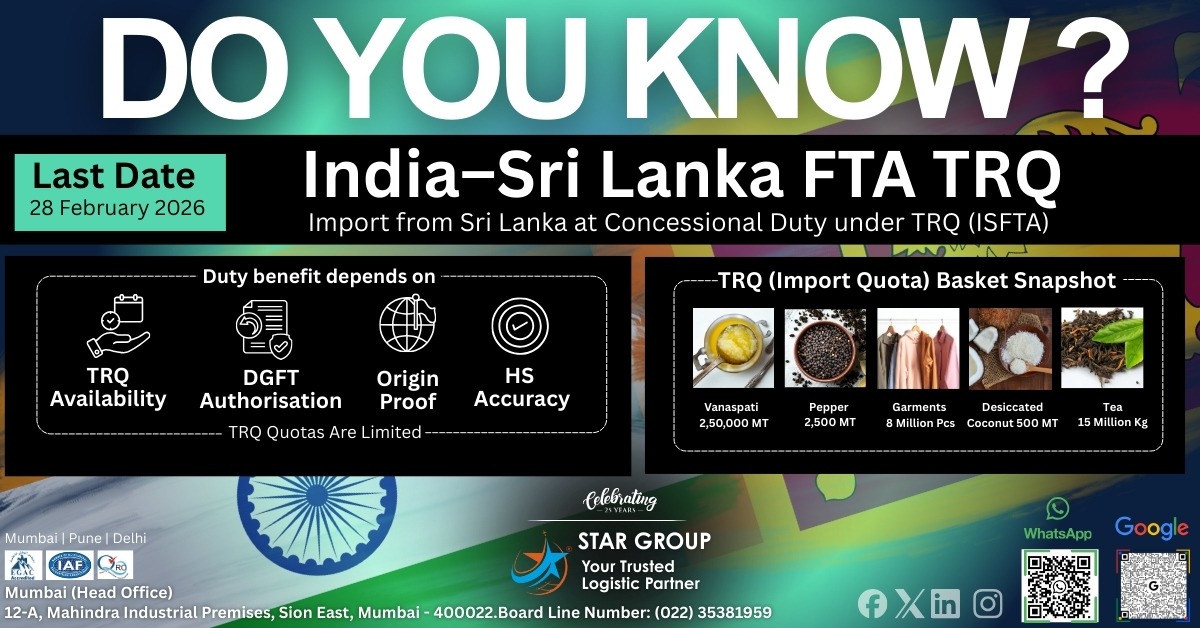
Under the India–Sri Lanka Free Trade Agreement (ISFTA), certain Sri Lanka–origin goods can be imported into India under a Tariff Rate Quota (TRQ) at concessional or Nil Customs duty. Once the notified annual quota is exhausted, imports attract normal tariff rates.
India–Sri Lanka TRQ Items & Annual Quota
The India–Sri Lanka TRQ framework covers a limited basket of commodities, each subject to strict annual quantity caps. Commonly used TRQ items include:
Garments (Apparel & Clothing Accessories) – 8 million pieces
Tea & Tea Preparations – 15 million kg
Desiccated Coconut - 500 MT
Additionally, DGFT minutes explicitly include Desiccated Coconut – 500 MT under the India–Sri Lanka TRQ basket.
Important note: While your Excel file listed four TRQ categories, CBIC Customs Notification also recognizes Desiccated Coconut as an eligible TRQ item for Sri Lanka-origin imports.
✅DGFT allocation minutes confirm these same quantities, including desiccated coconut, ensuring alignment between policy intent and operational execution.
Legal Notifications Enabling the TRQ
A. CBIC Notification No. 2/2007-Customs (05.01.2007)
This notification provides TRQ-linked Customs duty concessions for Sri Lanka-origin imports, including:
The concessional rate applies only within the notified TRQ quantity.
B. Customs Notification No. 26/2000-Customs (01.03.2000)
This is the foundational ISFTA notification, governing:
Garments (List 3) – 8 million pieces
Tea & Preparations (List 4) – 15 million kg
It also prescribes specific port and routing conditions, making compliance critical.
DGFT’s Role: How TRQ Is Actually Claimed
While Customs notifications create the duty benefit, TRQ is operationally implemented through DGFT.
DGFT’s TRQ mechanism:
Allocates quantities within the annual cap
Issues electronic TRQ authorisations
Links each authorisation to the relevant Customs notification
What a DGFT TRQ Authorisation Typically Contains
As per DGFT Appendix 2A, the authorisation includes:
Importer name & IEC
Tariff item / HS code
Linked Customs notification
Approved quantity
Validity period
This authorisation is mandatory for claiming TRQ benefits at the time of Customs clearance.
Recent Process Update You Can Cite
DGFT has updated Appendix 2A (as on 30.10.2025), reinforcing:
Standardised TRQ application workflows
Uniform authorisation formats
Clear data requirements for Customs linkage
????Practical takeaway: Even when TRQ product lists remain unchanged, procedural compliance keeps evolving, and importers must stay aligned with DGFT system updates.
Importer Compliance Checklist
Before planning a TRQ import from Sri Lanka, ensure:
HS code matches exact notification entries and exclusions
ISFTA Certificate of Origin is valid and complete
DGFT TRQ authorisation is obtained and valid
Any port / routing conditions mentioned in the notification are followed
Import planning is done early, as TRQ allocations are annual and time-bound
Conclusion
The India–Sri Lanka TRQ mechanism is a powerful duty-saving tool, but only when Customs notifications, origin compliance, and DGFT authorisation align perfectly. For importers of pepper, vanaspati, garments, tea, or desiccated coconut, TRQ should be treated as a documentation-driven and time-sensitive strategy, not a last-minute clearance option.
If you need assistance, we can help you map: HS Code → Applicable Notification → DGFT TRQ Process → End-to-End Documentation Checklist — ensuring your TRQ benefit is claimed correctly and without disputes.
Disclaimer:
This blog is for informational purposes only and is based on CBIC Customs Notifications and DGFT guidelines available at the time of writing. TRQ procedures, eligibility, and DGFT processes are subject to change, and readers are advised to verify the latest DGFT Notifications, Public Notices, and Customs updates before acting. This content does not constitute legal or professional advice.
Have any doubts? Please fill the form below to get in touch with us.
In this article, we are going to have a look at all the necessary documents required for the import and export procedure to be completed successfully.These import and export documents are essential to be kept in mind while importing or exporting goods.Let...
The Export clearance procedure is an important step while exporting goods from India.Customs Clearance is the process of authorization of a person or goods by the Customs Department.The authorization takes place after providing the proper customs clearanc...
In this article, we are going to discuss in detail the procedure of Import and Export in India.The Foreign Trade (Development and Regulation) Act, 1992, of India regulates the import and export of goods. It also facilitates the government to make necessar...
Advance Ruling is Trade Facilitation as per WTO agreementImporters and Exporters who have ambiguity about their goods Classification, Duty structure and Valuation method can go for Advance Ruling. Advance Ruling will ensure tariff classification, exemptio...
Duty Free Import Authorization Scheme (DFIA) ObjectiveThis scheme providing duty free inputs on post exports basis as a replenishment so that export product becomes competitive in the international market.DFIA is freely transferable. Eligibility Criteria...
Self-Sealing Permission Purpose Central Board of Indirect Taxes and Custom (CBIC ) has approved the program to promote exports Self Sealing Permission earlier was called as Factory Stuffing Permission; this permits containerize cargo to seal at their fact...
RESTRICTED LICENSEAs per the provisions of Exim Policies, The Central Government, in public interest, regulates the import or export of goods by means of a Negative List. This Negative Lists consist of goods for Export & import which are prohibited or res...
Brand Rate Fixation (Custom Act Section 75) When the manufacturer import the Raw material, Components & packing material after paying the Basic Custom Duty (BCD) & Social Welfare Surcharge (SWS) and utilizing the same for the manufacturing of export produ...
Preferential Trade Agreements A key benefit under PTA is preferential tariff, i.e. applicability of lower customs duty on import of goods from partner countries. India has notified separate rules for determining whether goods being imported from a country...
Status Holder Certificate All exporters of goods & services having an import-export code (IEC) number shall be eligible for recognition as a status holder on achieving specific turnover. Status recognition depends upon export performance An applicant shal...
Re- Import of Goods without payment of Duty Re-importing goods without payment of duty is allowed under various Customs notifications. Goods that were earlier exported can be brought back into the country without payment of import duties and taxes.Common...
Import of Goods for display in Trade Fairs and events without payment of Customs Duty Conditions: The importer must submit a Specific declaration, Re- export bond with bank guarantee 10% of duty amount. Imports by government entities, diplomatic missions,...
The Union Budget 2025-26 has unveiled transformative measures to bolster India's Micro, Small, and Medium Enterprises (MSMEs), recognizing their pivotal role in economic growth and employment generation.Enhanced MSME Classification CriteriaTo facilitate s...
IntroductionTo make international trade easier and more efficient for Indian businesses, the government has introduced a new digital platform called Bharat Trade Net (BTN). Announced during the Union Budget 2025, BTN aims to streamline trade processes, ma...
The Union Budget 2025-26 has introduced significant changes in customs duties related to the leather industry, benefiting both importers and exporters. Import of Wet Blue leather is now fully exempt from Basic Customs Duty (BCD).Export of Crust leather is...
The Union Budget 2025 has introduced a significant push for domestic manufacturing and value addition, particularly in the lithium-ion battery sector. With a growing emphasis on electric mobility and self-reliance, Finance Minister Nirmala Sitharaman anno...
The Indian government has taken a significant step towards strengthening the clean energy and electric vehicle (EV) sectors. In Budget 2025, Finance Minister Nirmala Sitharaman announced the exemption of customs duty on cobalt powder & waste, scrap of lit...
IntroductionIn today's rapidly evolving industrial landscape, ensuring the safety and quality of machinery and electrical equipment is paramount. The Bureau of Indian Standards (BIS) introduced Scheme X under the Conformity Assessment Regulations to addre...
The Ministry of Food Processing Industries (MoFPI), Government of India has issued a Notice Inviting Proposals for financial assistance to set up multi-product food irradiation units under the component scheme “Integrated Cold Chain and Value Addition Inf...
Under the India–Sri Lanka Free Trade Agreement (ISFTA), certain Sri Lanka–origin goods can be imported into India under a Tariff Rate Quota (TRQ) at concessional or Nil Customs duty. Once the notified annual quota is exhausted, imports attract normal tari...
Under the India–Mauritius CECPA, select products can be imported into India under a Tariff Rate Quota (TRQ). TRQ allows importers to claim a preferential in-quota duty rate for a notified quantity, subject to DGFT procedure and Customs compliance. What i...
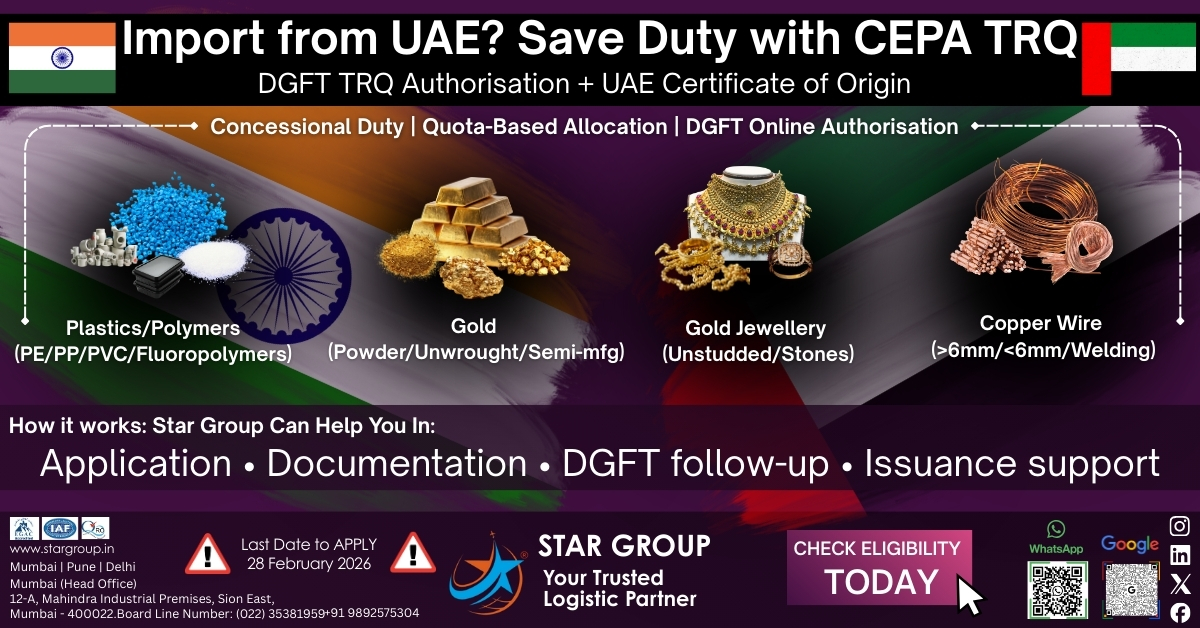
How to use DGFT TRQ authorisation to import select items from UAE at concessional customs duty (with official rules + product snapshot) What is TRQ under India–UAE CEPA?Under the India–UAE Comprehensive Economic Partnership Agreement (CEPA), certain produ...