
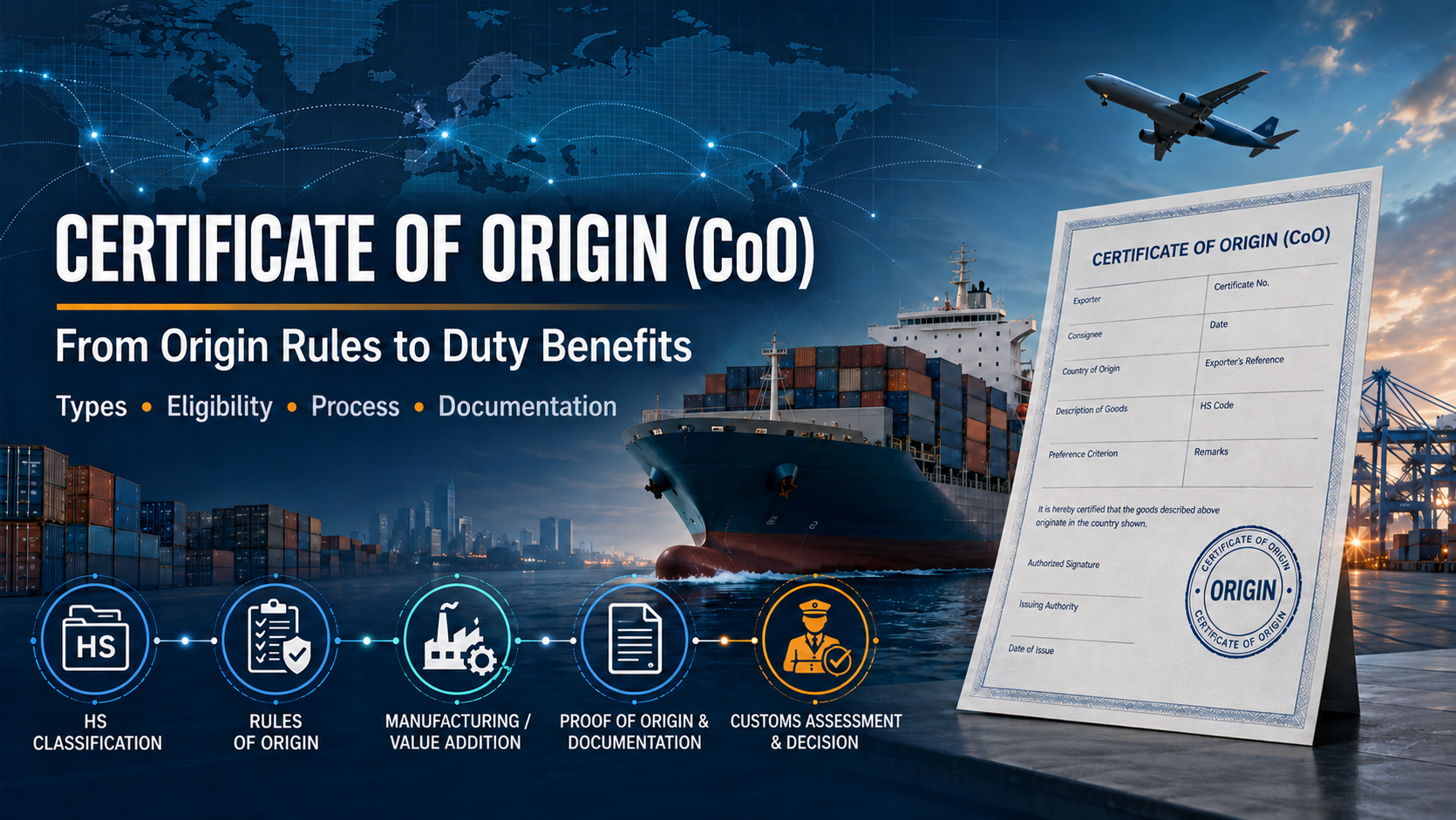
Certificate of Origin (CoO): A Complete Guide Meaning, Types, Rules, Process and Documents

August 05, 2026
Certificate of Origin (CoO): A Complete Guide Meaning, Types, Rules, Process and Documents

In international trade, the country from which goods are shipped is not always their country of origin.

A product may be exported from India, contain inputs sourced from several countries and still qualify—or fail to qualify—as Indian-origin, depending on the applicable origin rules. This is why a Certificate of Origin (CoO) is an important trade document.

A CoO provides evidence of where goods originate. In a preferential trade arrangement, the prescribed proof of origin can help the overseas importer claim a reduced or zero rate of customs duty. However, the document does not create origin by itself, and its issuance does not guarantee that the importing country will grant the tariff benefit.

Certificate of Origin at a Glance

Question

Practical answer

What does a CoO establish?

The origin of goods, subject to the applicable origin criteria

What are the two broad categories?

Preferential and Non-Preferential CoO

Who normally applies?

The exporter; supporting information may be required from the producer or manufacturer

Who normally uses it?

The overseas importer, buyer, bank, customs authority or another requesting organisation

Who issues it in India?

An agency authorised by DGFT for the applicable certificate or arrangement

Does it guarantee a duty concession?

No. Product coverage, the tariff schedule, Rules of Origin and importing-country requirements must also be satisfied

Is it required for services?

The CoO discussed here relates to goods, not the origin of services

What Is a Certificate of Origin?

The DGFT Handbook of Procedures describes a CoO as an instrument used to establish evidence of the origin of goods imported into a country.

In simple terms, it identifies the economic nationality of goods. Origin is not determined merely by:

the exporter’s registered address;

the port from which the shipment leaves;

the country in which the goods were packed or labelled; or

the country where only simple or minimal operations were performed.

For goods made entirely in one country, origin may be relatively straightforward. For manufactured products containing imported inputs, origin normally depends on the processing undertaken, the HS classification of the finished goods and inputs, value-addition requirements and the product-specific rule under the relevant trade arrangement.

The CoO supports an origin claim. The applicable Rules of Origin determine whether that claim is valid.

When and Why Is a CoO Required?

A CoO may be required when:

an overseas importer wants to claim a preferential customs-duty rate;

the buyer or purchase contract requires origin evidence;

a bank requests it for trade-finance or documentary-credit purposes;

the destination country requires origin information for customs, regulatory or trade-policy purposes;

a tender or government procurement condition specifies a country of origin; or

another commercial or compliance process requires formal origin evidence.

A CoO is not automatically mandatory for every export shipment. The requirement depends on the destination country, product, trade arrangement, buyer’s contract and the purpose for which origin evidence is needed.

The Two Main Types of Certificate of Origin

1. Preferential Certificate of Origin

A Preferential CoO is used under an applicable Free Trade Agreement, Preferential Trade Agreement, CEPA, CECA, ECTA, CECPA or another preferential arrangement.

It supports the importer’s claim for a reduced or zero customs-duty rate only when all relevant conditions are met, including:

the product is covered by the applicable tariff schedule;

a preferential rate is available for that product;

the product satisfies the applicable Rule of Origin;

the prescribed origin criterion is correctly declared;

the required proof of origin is valid and complete; and

any consignment, transport, invoicing and claim conditions are fulfilled.

An agreement may also prescribe an origin declaration, statement on origin or another self-certification mechanism for eligible exporters. Such mechanisms apply only where the agreement and current implementing procedure expressly permit them; they are not a general substitute for an agency-issued CoO.

2. Non-Preferential Certificate of Origin

A Non-Preferential CoO evidences the country of origin for ordinary commercial, regulatory or trade purposes. It may be requested by a buyer, bank, tendering authority, customs authority or government body.

It does not confer an FTA-related tariff preference.

Under paragraph 2.93 of the DGFT Handbook of Procedures, the goods must be manufactured by the exporting entity within the meaning of “manufacture” under the Foreign Trade Policy. Where imported inputs are used, the operations performed in India must go beyond the listed simple or minimal processes. Activities such as simple packing, repacking, labelling, sorting, simple assembly or mere dilution are not sufficient by themselves to confer Indian origin.

Preferential vs Non-Preferential CoO

Point

Preferential CoO

Non-Preferential CoO

Primary purpose

Support a claim for a reduced or zero tariff

Evidence origin for commercial or regulatory use

Basis

Applicable preferential arrangement and its Rules of Origin

Non-Preferential origin criteria and requesting-party requirements

User

Generally the overseas importer claiming preference

Buyer, bank, customs, tendering authority or another requesting body

Duty benefit

Possible, if every applicable condition is met

No preferential-duty right by itself

Documentation

Agreement- and product-specific

Based on DGFT Non-Preferential criteria and the issuing agency’s requirements

Special Origin Mechanisms Exporters Should Understand

These mechanisms do not replace the two broad categories above, but may apply in specific situations:

Agreement-specific self-certification: A self-declaration, statement on origin or similar mechanism may be used only when expressly permitted under the relevant arrangement and operational procedure.

Non-Preferential self-certification: The DGFT Handbook permits eligible manufacturer-exporters holding Status Holder recognition to self-certify qualifying Indian-origin goods in the prescribed format.

Back-to-Back Non-Preferential CoO: An authorised agency may issue this for goods that are not of Indian origin and are involved in re-export, trans-shipment or merchanting trade, based on documentary evidence of the foreign country of origin.

Exporters should identify the exact mechanism before preparing the application. A procedure available under one agreement or transaction cannot automatically be used for another.

How Rules of Origin Determine Eligibility

Rules of Origin are the legal and technical tests used to determine whether goods qualify as originating under a particular trade arrangement.

Depending on the product and agreement, the rule may involve one or more of the following:

Wholly obtained or produced: Generally relevant to agricultural, animal, mineral and naturally obtained goods.

Change in Tariff Classification: The finished product must satisfy a prescribed change in HS classification compared with non-originating inputs.

Domestic or Regional Value Content: A specified percentage of value must originate within the participating country or region.

Specific manufacturing or processing rule: A defined production process must take place in the participating country.

Cumulation: Eligible materials or processing from specified partner countries may be treated as originating, subject to the agreement.

Tolerance or de minimis rule: Limited use of certain non-originating materials may be allowed, where the agreement provides for it.

Minimal-operation restriction: Simple operations may be insufficient to confer origin.

Consignment or transport conditions: Some arrangements prescribe direct-consignment, non-manipulation or related evidence requirements.

Different products under the same agreement may have different product-specific Rules of Origin. The correct HS classification and the exact rule for that tariff line must therefore be checked before a preferential benefit is promised to the buyer.

Who Obtains, Issues and Uses a CoO?

Party

Typical responsibility

Exporter

Determines the requirement, applies for an agency-issued CoO and submits accurate information

Manufacturer or producer

Provides manufacturing, input-origin and costing records where required

Authorised issuing agency

Reviews the application and issues the CoO in the prescribed manner

Overseas importer

Presents the prescribed proof of origin and claims the applicable tariff treatment

Importing-country customs

Examines the claim and decides whether preferential treatment should be granted

Both manufacturer-exporters and merchant-exporters may encounter CoO requirements. A merchant-exporter should be able to obtain the supporting origin and manufacturing records from the producer when the applicable procedure requires them.

Who Issues Certificates of Origin in India?

There is no single issuing agency for every CoO.

DGFT notifies authorised agencies through the relevant appendices, including Appendix 2B, 2C, 2D and 2E, depending on the agreement, preference scheme and certificate type. Preferential issuing agencies may include the Export Inspection Council and Export Inspection Agencies, sector-specific boards, councils and other notified bodies. Non-Preferential agencies include notified chambers, councils, associations and other authorised organisations.

Appendix

What it covers

When it is relevant

Appendix 2B

Agreement-wise list of agencies authorised to issue Preferential CoOs

For exports seeking benefits under an FTA, PTA, CEPA, CECA or similar agreement

Appendix 2C

Agencies and procedures relating to GSP certification; it also contains the EU-GSP REX framework

When goods are exported under an applicable Generalised System of Preferences scheme

Appendix 2D

Agencies authorised to issue Preferential CoOs specifically under SAPTA and APTA

Only when exporting under SAPTA or the Asia-Pacific Trade Agreement

Appendix 2E

Agencies authorised to issue Non-Preferential CoOs

When origin evidence is required for commercial, regulatory, banking, tender or customs purposes without an FTA duty concession

How to Apply for an Agency-Issued CoO

The practical sequence is:

Confirm why the CoO is required. Determine whether the requirement is preferential, non-preferential or agreement-specific.

Confirm product classification. Verify the product description and applicable HS code.

Check preferential eligibility, where relevant. Review the tariff schedule and product-specific Rule of Origin before making a claim.

Identify the correct issuing agency. The available agencies and offices are displayed on Trade Connect according to the selected certificate type and agreement.

Prepare the origin file. Collect the invoice and all applicable production, input, costing, supplier and shipment records.

Complete the online application. Enter exporter, importer, invoice, product, origin and shipment information on the designated portal.

Upload the required documents. Requirements vary by certificate type, product, arrangement and issuing agency.

Authenticate and submit. The Trade Connect guide provides for a registered Digital Signature Certificate or Aadhaar e-sign, as applicable, followed by payment.

Respond to any deficiency. Clarify or correct the application and provide additional evidence when requested.

Download and share the issued CoO. The exporter sends the relevant proof to the overseas buyer or importer for the destination-country process.

Retain the origin records. Keep the complete supporting file for the period required under the applicable arrangement and laws.

Issuance should not be treated as the end of the compliance process. The origin claim may later be selected for verification.

Documents and Records Exporters Should Keep Ready

There is no universal document checklist for every CoO.

The DGFT Trade Connect exporter guide identifies the export invoice as a mandatory portal attachment and allows other documents to be requested. For a Non-Preferential CoO, paragraph 2.93 of the Handbook specifically requires the invoice and packing list to be uploaded.

Depending on the certificate type, product, agreement and issuing agency, the application or supporting origin file may include:

commercial or export invoice;

packing list;

exporter and importer details;

product description and HS code;

Shipping Bill and transport details, where applicable;

Bill of Lading or Airway Bill, where applicable;

prescribed exporter declaration;

Bill of Materials;

HS codes and countries of origin of inputs;

manufacturing or process-flow details;

domestic purchase and import invoices for inputs;

supplier or manufacturer declarations;

evidence distinguishing originating and non-originating materials;

production and input-consumption records;

cost sheet and value-addition or Regional Value Content calculation;

proof of consignment or transport conditions, where prescribed; and

agreement-specific declarations or certificates.

Only the documents applicable to the relevant transaction should be treated as required. Exporters should confirm the current checklist with the selected issuing agency and under the relevant agreement.

The Key Takeaway

A Certificate of Origin is more than a routine export document. It connects product classification, sourcing, manufacturing, origin calculations, commercial documents and destination-country customs requirements.

For a reliable origin claim, exporters should follow this sequence:

Identify the correct product and tariff treatment.
Apply the relevant Rules of Origin.
Prepare defensible supporting records.
Use the prescribed proof-of-origin procedure.
Keep the claim ready for verification.

When these elements are aligned, a CoO can support smoother trade documentation and, where a preferential arrangement applies, help the overseas importer access the available tariff benefit.

Official References

DGFT Handbook of Procedures 2023—Chapter 2

DGFT Trade Connect—Certificate of Origin

DGFT Trade Connect—User Guide for Exporters

DGFT Notification No. 05/2026-27 dated 7 April 2026

DGFT Public Notice No. 01/2026-27 dated 7 April 2026

DGFT Appendices, including Appendix 2B and Appendix 2E

Disclaimer

This blog is intended solely for general awareness and educational purposes and should not be treated as legal, tax, customs or professional advice.

Certificate of Origin requirements, tariff concessions, Rules of Origin, product-specific rules, documentary evidence, verification procedures and retention periods vary by product, destination, trade arrangement and transaction. Government policies, portal processes, authorised-agency lists and destination-country requirements may be amended from time to time.

Businesses should verify the latest applicable Foreign Trade Policy, Handbook of Procedures, DGFT notifications and public notices, relevant trade agreement, tariff schedule, Rules of Origin and importing-country requirements before acting or promising a tariff benefit.

Frequently Asked Questions

No. Its requirement depends on the product, destination, trade arrangement, buyer’s contract and commercial or regulatory purpose.

No. The product must be covered by the tariff schedule, satisfy the applicable Rule of Origin and meet all other claim conditions. The importing-country customs authority decides whether to grant the preference.

Yes, where the applicable procedure permits. The merchant-exporter may need origin declarations, manufacturing records and input details from the producer to substantiate the claim.

The exporter normally obtains and supplies it. The overseas importer generally uses the prescribed proof of origin when making the customs or commercial claim at destination.

Not as a general rule. Agency-issued CoOs must come from DGFT-authorised agencies through the designated electronic platform. Self-certification or a statement on origin may be used only where the applicable agreement and notified procedure expressly permit it. The Handbook also provides a specific Non-Preferential self-certification route for eligible manufacturer Status Holders.

No. Goods may be shipped from or routed through a country without acquiring that country’s origin. Origin depends on the relevant origin criteria and the production performed.

Not ordinarily. Under the Non-Preferential criteria, listed simple or minimal operations are insufficient by themselves. Preferential agreements also commonly contain minimal-operation rules.

Generally, a CoO is linked to the specified shipment or invoice details. Any facility for multiple shipments, blanket declarations or long-term statements must be expressly allowed by the relevant arrangement.

Retrospective or post-shipment issuance is agreement- and procedure-specific. Exporters should not assume that it is available and should check the applicable rules before shipment.

The correction or replacement procedure depends on the certificate type and applicable arrangement. The Handbook provides for an online in-lieu application for correction of a Non-Preferential eCoO; preferential procedures must be checked separately.

There is no single retention period for every certificate. Records should be preserved for the period prescribed by the relevant agreement, DGFT or issuing-agency procedure, destination-country rule and other applicable laws.

Rules of Origin are the qualification tests. A CoO or other permitted proof of origin records and supports the resulting origin claim.

Have any doubts? Please fill the form below to get in touch with us.

Related Blogs

What are the documents required for import & export

What are the documents required for import & export

April 04, 2022

In this article, we are going to have a look at all the necessary documents required for the import and export procedure to be completed successfully.These import and export documents are essential to be kept in mind while importing or exporting goods.Let...
What is the procedure of Custom Clearance for Export?

What is the procedure of Custom Clearance for Export?

April 04, 2022

The Export clearance procedure is an important step while exporting goods from India.Customs Clearance is the process of authorization of a person or goods by the Customs Department.The authorization takes place after providing the proper customs clearanc...

What is the procedure of import and export in India?

What is the procedure of import and export in India?

April 04, 2022

In this article, we are going to discuss in detail the procedure of Import and Export in India.The Foreign Trade (Development and Regulation) Act, 1992, of India regulates the import and export of goods. It also facilitates the government to make necessar...

Advance Ruling

Advance Ruling

September 18, 2024

Advance Ruling is Trade Facilitation as per WTO agreementImporters and Exporters who have ambiguity about their goods Classification, Duty structure and Valuation method can go for Advance Ruling. Advance Ruling will ensure tariff classification, exemptio...

Duty Free Import Authorization Scheme (DFIA)

Duty Free Import Authorization Scheme (DFIA)

October 02, 2024

Duty Free Import Authorization Scheme (DFIA) ObjectiveThis scheme providing duty free inputs on post exports basis as a  replenishment so that export product becomes competitive in the international market.DFIA is freely transferable. Eligibility Criteria...

Self-Sealing Permission ( SSP )

Self-Sealing Permission ( SSP )

October 03, 2024

Self-Sealing Permission Purpose Central Board of Indirect Taxes and Custom (CBIC ) has approved the program to promote exports Self Sealing Permission earlier was called as Factory Stuffing Permission; this permits containerize cargo to seal at their fact...

RESTRICTED LICENSE

RESTRICTED LICENSE

October 16, 2024

RESTRICTED LICENSEAs per the provisions of Exim Policies, The Central Government, in public interest, regulates the import or export of goods by means of a Negative List. This Negative Lists consist of goods for Export & import which are prohibited or res...

Brand Rate Fixation (Custom Act Section 75)

Brand Rate Fixation (Custom Act Section 75)

October 16, 2024

Brand Rate Fixation (Custom Act Section 75) When the manufacturer import the Raw material, Components & packing material after paying the Basic Custom Duty (BCD) & Social Welfare Surcharge (SWS) and utilizing the same for the manufacturing of export produ...

Preferential Trade Agreements

Preferential Trade Agreements

October 16, 2024

Preferential Trade Agreements A key benefit under PTA is preferential tariff, i.e. applicability of lower customs duty on import of goods from partner countries. India has notified separate rules for determining whether goods being imported from a country...

Status Holder Certificate

Status Holder Certificate

October 23, 2024

Status Holder Certificate All exporters of goods & services having an import-export code (IEC) number shall be eligible for recognition as a status holder on achieving specific turnover. Status recognition depends upon export performance An applicant shal...

Re- Import of Goods without payment of Duty

Re- Import of Goods without payment of Duty

October 23, 2024

 Re- Import of Goods without payment of Duty Re-importing goods without payment of duty is allowed under various Customs notifications. Goods that were earlier exported can be brought back into the country without payment of import duties and taxes.Common...

Import of Goods for display in Trade Fairs and events without payment of Customs Duty

Import of Goods for display in Trade Fairs and events without payment of Customs Duty

November 07, 2024

Import of Goods for display in Trade Fairs and events without payment of Customs Duty Conditions: The importer must submit a Specific declaration, Re- export bond with bank guarantee 10% of duty amount. Imports by government entities, diplomatic missions,...

Union Budget 2025: Boosting MSMEs with New Credit Schemes and Classification Changes

Union Budget 2025: Boosting MSMEs with New Credit Schemes and Classification Changes

February 21, 2025

The Union Budget 2025-26 has unveiled transformative measures to bolster India's Micro, Small, and Medium Enterprises (MSMEs), recognizing their pivotal role in economic growth and employment generation.Enhanced MSME Classification CriteriaTo facilitate s...

Understanding Bharat Trade Net (BTN): Simplifying India's International Trade

Understanding Bharat Trade Net (BTN): Simplifying India's International Trade

February 22, 2025

IntroductionTo make international trade easier and more efficient for Indian businesses, the government has introduced a new digital platform called Bharat Trade Net (BTN). Announced during the Union Budget 2025, BTN aims to streamline trade processes, ma...

India’s Budget 2025-26: Duty Exemptions to Boost the Leather Industry

India’s Budget 2025-26: Duty Exemptions to Boost the Leather Industry

February 22, 2025

The Union Budget 2025-26 has introduced significant changes in customs duties related to the leather industry, benefiting both importers and exporters. Import of Wet Blue leather is now fully exempt from Basic Customs Duty (BCD).Export of Crust leather is...

Fueling Self-Reliance: India’s Push for Lithium-Ion Battery Manufacturing

Fueling Self-Reliance: India’s Push for Lithium-Ion Battery Manufacturing

February 22, 2025

The Union Budget 2025 has introduced a significant push for domestic manufacturing and value addition, particularly in the lithium-ion battery sector. With a growing emphasis on electric mobility and self-reliance, Finance Minister Nirmala Sitharaman anno...

Budget 2025: Boost for Clean Energy – Duty Exemptions on Cobalt Powder &waste, Scrap of Lithium-Ion Battery & 12 Critical Minerals

Budget 2025: Boost for Clean Energy – Duty Exemptions on Cobalt Powder &waste, Scrap of Lithium-Ion Battery & 12 Critical Minerals

February 22, 2025

The Indian government has taken a significant step towards strengthening the clean energy and electric vehicle (EV) sectors. In Budget 2025, Finance Minister Nirmala Sitharaman announced the exemption of customs duty on cobalt powder & waste, scrap of lit...

Comprehensive Guide to BIS Scheme X Certification: Ensuring Safety and Compliance in Machinery and Electrical Equipment

Comprehensive Guide to BIS Scheme X Certification: Ensuring Safety and Compliance in Machinery and Electrical Equipment

September 04, 2025

IntroductionIn today's rapidly evolving industrial landscape, ensuring the safety and quality of machinery and electrical equipment is paramount. The Bureau of Indian Standards (BIS) introduced Scheme X under the Conformity Assessment Regulations to addre...

MoFPI Invites Proposals for Multi-Product Food Irradiation Units Under PMKSY: Eligibility, Grant Pattern & How to Apply

MoFPI Invites Proposals for Multi-Product Food Irradiation Units Under PMKSY: Eligibility, Grant Pattern & How to Apply

January 12, 2026

The Ministry of Food Processing Industries (MoFPI), Government of India has issued a Notice Inviting Proposals for financial assistance to set up multi-product food irradiation units under the component scheme “Integrated Cold Chain and Value Addition Inf...

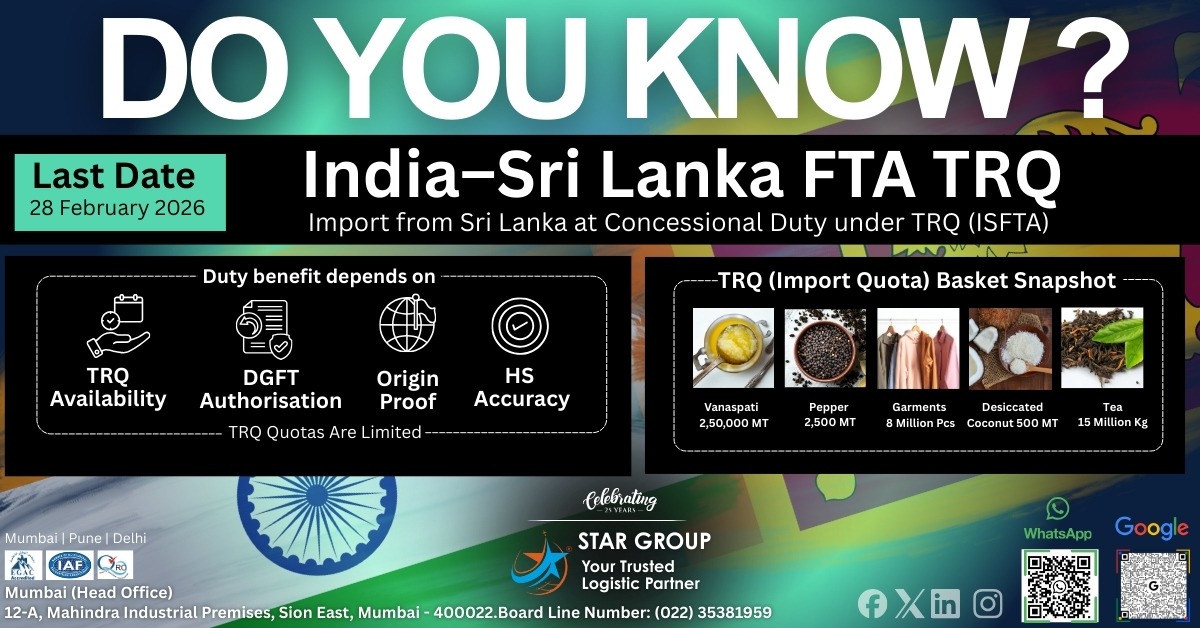
India–Sri Lanka FTA TRQ (Import Quota): Notifications, Quota Limits & How to Use the Benefit

India–Sri Lanka FTA TRQ (Import Quota): Notifications, Quota Limits & How to Use the Benefit

February 13, 2026

Under the India–Sri Lanka Free Trade Agreement (ISFTA), certain Sri Lanka–origin goods can be imported into India under a Tariff Rate Quota (TRQ) at concessional or Nil Customs duty. Once the notified annual quota is exhausted, imports attract normal tari...

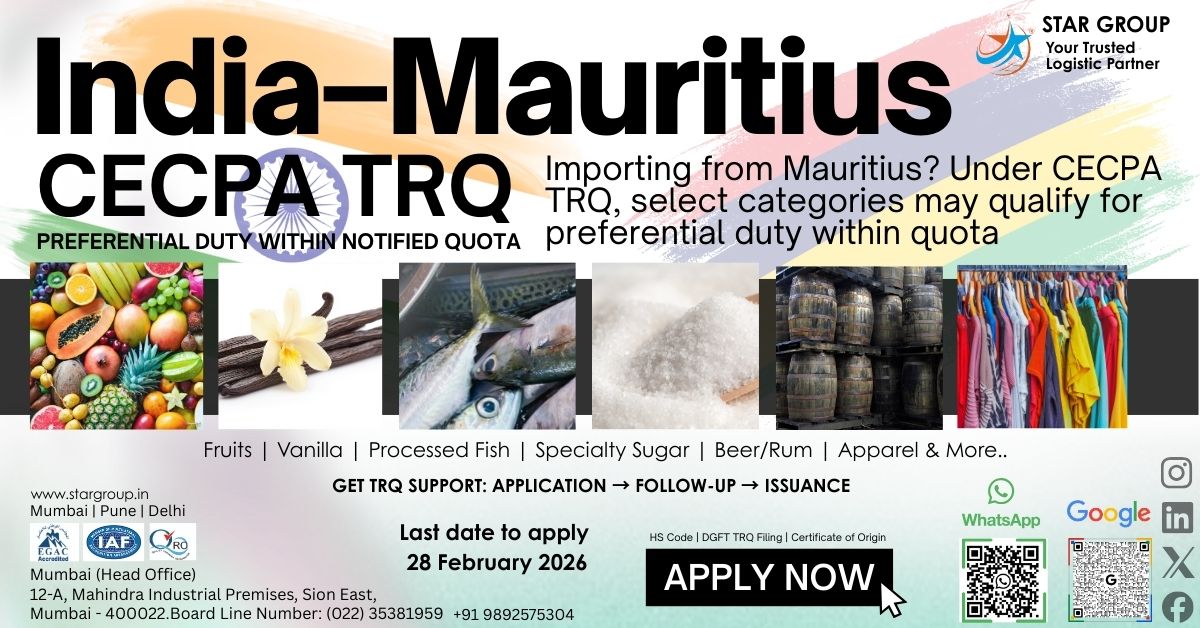
India–Mauritius CECPA TRQ for Indian Importers: Products, Quota, HS Codes & DGFT Process

India–Mauritius CECPA TRQ for Indian Importers: Products, Quota, HS Codes & DGFT Process

February 19, 2026

Under the India–Mauritius CECPA, select products can be imported into India under a Tariff Rate Quota (TRQ). TRQ allows importers to claim a preferential in-quota duty rate for a notified quantity, subject to DGFT procedure and Customs compliance.  What i...

India–UAE CEPA TRQ: DGFT Process, Eligible Importers, Product List & Duty Concessions

India–UAE CEPA TRQ: DGFT Process, Eligible Importers, Product List & Duty Concessions

February 20, 2026

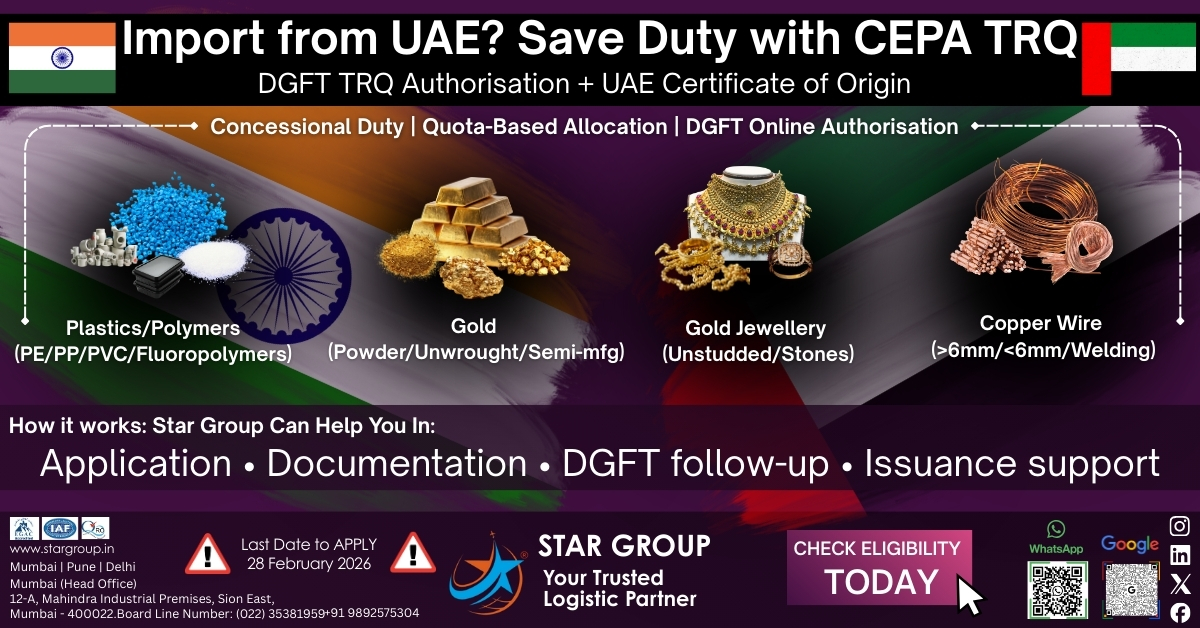
How to use DGFT TRQ authorisation to import select items from UAE at concessional customs duty (with official rules + product snapshot) What is TRQ under India–UAE CEPA?Under the India–UAE Comprehensive Economic Partnership Agreement (CEPA), certain produ...

DGFT Extends TRQ Application Last Date to 15 March 2026 for FY 2026-27

DGFT Extends TRQ Application Last Date to 15 March 2026 for FY 2026-27

February 25, 2026

Country-wise TRQ Items Covered Under Sri Lanka, Mauritius, Nepal, UAE & MercosurThe Directorate General of Foreign Trade (DGFT), Ministry of Commerce & Industry, has issued Public Notice No. 50/2025-26 dated 24 February 2026, extending the deadline for fi...

Interest Subvention for MSME Exporters (DGFT – EPM Niryat Prothsahan): What Small Exporters Need to Know (Trade Notice No. 20/2025-26, dated 02 Jan 2026)

Interest Subvention for MSME Exporters (DGFT – EPM Niryat Prothsahan): What Small Exporters Need to Know (Trade Notice No. 20/2025-26, dated 02 Jan 2026)

March 04, 2026

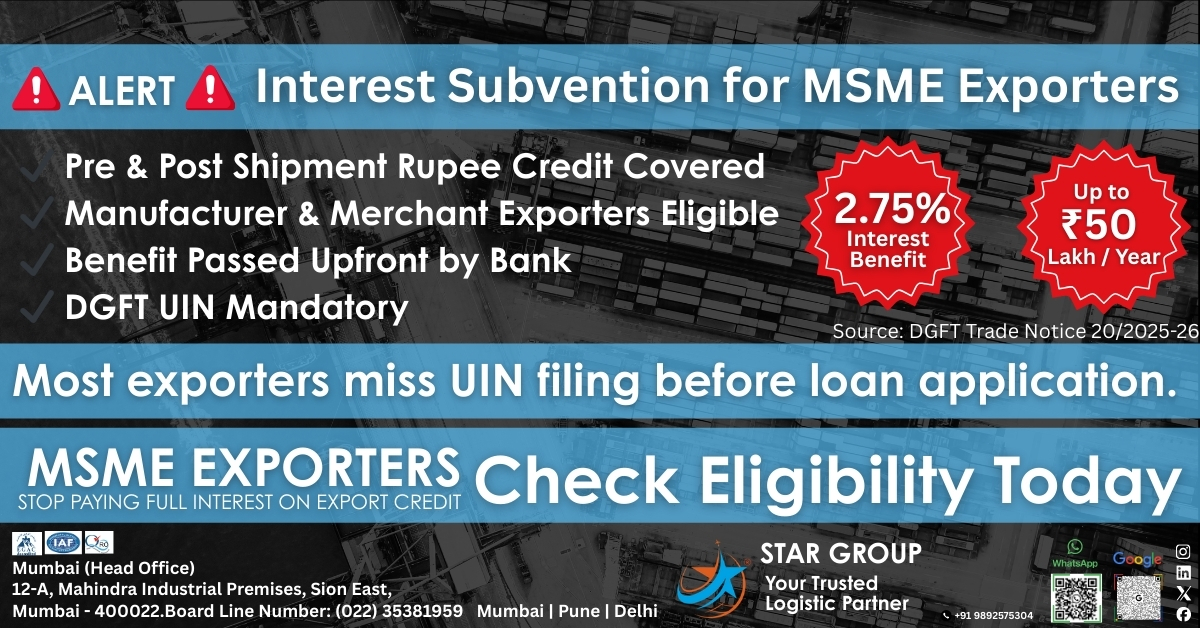
OverviewDGFT has launched “Interest Subvention for Pre- and Post-Shipment Export Credit” under the Export Promotion Mission (EPM) – Niryat Prothsahan through Trade Notice No. 20/2025-26 dated 02 January 2026, with immediate effect. The intervention is ope...

Import Duty Payment Just Got Easier: CBIC Extends Deferred Payment to 30 Days (Effective Feb 2026)

Import Duty Payment Just Got Easier: CBIC Extends Deferred Payment to 30 Days (Effective Feb 2026)

March 12, 2026

Do you know that the Government of India now allows eligible importers to pay customs duty after 30 days instead of paying it upfront?In a major relief for compliant importers and domestic manufacturers, the Central Board of Indirect Taxes and Customs (CB...

Eligible Manufacturer Importer (EMI) Scheme: Why This Customs Update Matters for Manufacturer-Importers

Eligible Manufacturer Importer (EMI) Scheme: Why This Customs Update Matters for Manufacturer-Importers

May 15, 2026

The Central Board of Indirect Taxes and Customs (CBIC) has introduced an important facilitation measure for eligible manufacturer-importers through the Eligible Manufacturer Importer (EMI) Scheme. Under this framework, approved EMI entities can clear impo...

Transition Facilitation (Quality Control) Order, 2026: What Businesses Should Know

Transition Facilitation (Quality Control) Order, 2026: What Businesses Should Know

June 30, 2026

The Ministry of Commerce and Industry, through the Department for Promotion of Industry and Internal Trade (DPIIT), has notified the Transition Facilitation (Quality Control) Order, 2026.This notification is important for businesses dealing with selected ...

EDPMS & IDPMS Reconciliation: How Exporters and Importers Can Clear Pending Entries

EDPMS & IDPMS Reconciliation: How Exporters and Importers Can Clear Pending Entries

August 05, 2026

An export payment may have been received—or an import payment completed—yet the related Shipping Bill or Bill of Entry may still appear as outstanding in the banking system.These pending records can arise from missing documents, incorrect references, diff...

Certificate of Origin (CoO): A Complete Guide Meaning, Types, Rules, Process and Documents

Certificate of Origin (CoO): A Complete Guide Meaning, Types, Rules, Process and Documents

August 05, 2026

In international trade, the country from which goods are shipped is not always their country of origin.A product may be exported from India, contain inputs sourced from several countries and still qualify—or fail to qualify—as Indian-origin, depending on ...

India–Oman CEPA TRQ 2026–27: Eligible Products, In-Quota Duty Rates and Application Guide

India–Oman CEPA TRQ 2026–27: Eligible Products, In-Quota Duty Rates and Application Guide

August 05, 2026

The Directorate General of Foreign Trade (DGFT) has invited applications for Tariff Rate Quota (TRQ) allocation under the India–Oman Comprehensive Economic Partnership Agreement (CEPA) for FY 2026–27.Applications can be submitted from 4 August 2026 to 19 ...

Download Broucher

Get a Quick Quote
for Your Import-Export & Logistics Needs