
India–Oman CEPA TRQ 2026–27: Eligible Products, In-Quota Duty Rates and Application Guide

August 05, 2026
India–Oman CEPA TRQ 2026–27: Eligible Products, In-Quota Duty Rates and Application Guide

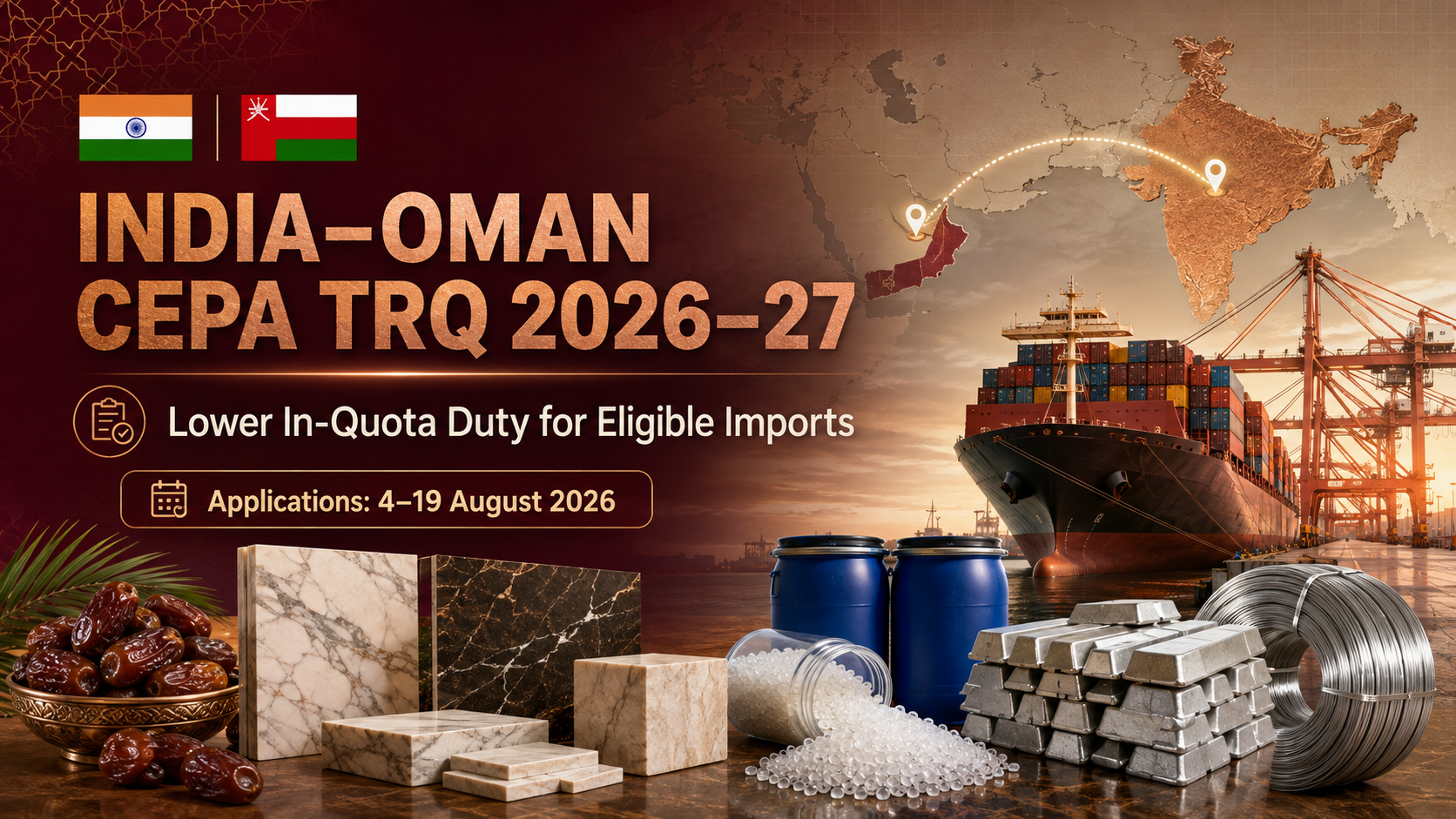
The Directorate General of Foreign Trade (DGFT) has invited applications for Tariff Rate Quota (TRQ) allocation under the India–Oman Comprehensive Economic Partnership Agreement (CEPA) for FY 2026–27.

Applications can be submitted from 4 August 2026 to 19 August 2026 for specified imports of dates, marble, chemicals, polymers, plastics and aluminium products from Oman.

For eligible importers, a TRQ can provide access to a lower customs-duty rate within an allocated quantity. The benefit, however, is neither universal nor automatic. It depends on DGFT allocation, Omani origin, the correct HS classification, prescribed documentation and acceptance of the claim by Indian Customs.

What Has Changed Under the India–Oman CEPA?

Three measures together operationalise the present TRQ opportunity:

Customs Notification No. 20/2026-Customs dated 31 May 2026, effective from 1 June 2026, notified the India–Oman CEPA tariff concessions, including the in-quota BCD and AIDC rates.

DGFT Public Notice No. 20/2026–27 dated 13 July 2026 amended paragraph 2.92 and Appendix 2A of the Handbook of Procedures 2023 to add the India–Oman CEPA TRQ products and application procedure.

DGFT Public Notice No. 24/2026–27 dated 3 August 2026 opened the FY 2026–27 application window from 4–19 August 2026 and specified the quota quantities available for the remaining part of the financial year.

The result is a product-specific import opportunity: eligible goods of Omani origin may access the notified concessional rate only within a valid DGFT TRQ authorisation and its allocated quantity.

What Is a Tariff Rate Quota?

A Tariff Rate Quota permits a specified quantity of eligible goods to be imported at a lower in-quota duty rate. Imports exceeding the allocated quantity, made without a valid authorisation or cleared outside its validity period do not receive the TRQ concession and are subject to the otherwise applicable duty.

A TRQ therefore does not make the product freely importable at the lower rate for every importer. It combines:

a notified product and HS code;

a limited quota quantity;

an in-quota customs-duty rate;

a DGFT allocation process; and

origin, documentation and Customs conditions.

India–Oman CEPA TRQ Duty Comparison for FY 2026–27

The following table covers all 30 tariff lines with positive FY 2026–27 quota quantities invited through DGFT Public Notice No. 24/2026–27. Tariff lines sharing one combined quota and the same rate are grouped together for clarity.

How to read the comparison: “MFN/reference rate” is the benchmark recorded in DGFT’s TRQ schedule. It should not be treated as the net duty historically paid in every transaction, because another exemption or product-specific notification may have applied. “In-quota rate” is the FY 2026–27 CEPA rate available subject to all TRQ conditions.

Product and HS code(s)FY 2026–27 quotaDGFT MFN/reference rateCEPA in-quota rate: BCD + AIDCRate differenceSimple indicative difference per ₹10 lakh assessable value*
Fresh and other dates — 08041010, 080410902,000 MT combined30%0% 30 points₹3,00,000
Marble and travertine blocks — 251512101,00,000 MT40%25%15 points₹1,50,000
Marble and travertine slabs — 2515122015,00,000 sq. mtr.40%25%15 points₹1,50,000
Ethylene glycol (ethanediol/MEG) — 290531001,50,000 MT5%4.50%0.50 point₹5,000
Linear alkylbenzenes — 381700111,049 MT7.50%6.75%0.75 point₹7,500
Specified polyethylene products — 39011010, 39011020, 39011090, 39012000, 39014010, 39014090, 3901900075,000 MT combined7.50%6.75%0.75 point₹7,500
Polypropylene and propylene copolymers — 39021000, 39023000, 3902900010,700 MT combined7.50%6.75%0.75 point₹7,500
Other polystyrene — 3903199034.802 MT7.50%6.75%0.75 point₹7,500
ABS copolymers — 390330001.054 MT7.50%6.75%0.75 point₹7,500
Suspension-grade PVC resin — 39041020166.666 MT10%6.75%3.25 points**₹32,500**
Other PVC — 39041090355.937 MT10%6.75%3.25 points**₹32,500**
Non-plasticised PVC — 390421006 MT10%6.75%3.25 points**₹32,500**
PET flakes and specified primary forms — 39076110, 39076190, 390769302,000 MT combined7.50%6.75%0.75 point₹7,500
Worked marble blocks, tiles and monumental stone — 68022110, 68022120, 6802219015,00,000 sq. mtr. combined40%35%5 points₹50,000
Non-alloyed aluminium ingots — 7601101030,434.909 MT7.50%6.75%0.75 point₹7,500
Aluminium-alloy ingots — 7601201081.296 MT7.50%6.75%0.75 point₹7,500
Non-alloyed aluminium wire exceeding 7 mm — 76051100199.1 MT7.50%6.75%0.75 point₹7,500

* The illustrative difference is a simple comparison of the stated MFN/reference rate with the notified in-quota BCD and AIDC rates on ₹10 lakh of customs assessable value. It is not a landed-cost calculation and excludes Social Welfare Surcharge, IGST, anti-dumping duty, safeguard duty, other levies, valuation adjustments and the effect of tax credits.

** The DGFT schedule records a 10% MFN/reference rate for the specified PVC lines. A different effective normal rate may be available under another exemption on the date of import. The actual incremental saving should therefore be verified transaction by transaction before being quoted commercially.

Where Is the Commercial Advantage Strongest?

The scale of benefit varies materially by product:

Dates: The 30% reference rate falls to 0% in-quota BCD and AIDC. This is the clearest rate advantage in the current schedule.

Raw marble blocks and slabs: The combined notified burden falls from the 40% reference benchmark to 25%, subject to the applicable minimum import price and TRQ conditions.

Worked marble: The FY 2026–27 in-quota structure is 15% BCD plus 20% AIDC, compared with a 40% reference rate.

PVC: The schedule shows a larger percentage-point reduction than most other polymers, but the effective normal rate must be checked before calculating the real saving.

MEG, LAB, PE, PP, PET, polystyrene, ABS and aluminium: The initial rate reduction is smaller, but even a 0.50–0.75 percentage-point difference may be commercially relevant for high-value or bulk imports.

Lower customs duty can improve landed cost, sourcing flexibility and price competitiveness. It does not necessarily translate into an identical reduction in the final product price; freight, insurance, exchange rates, port costs, other duties, taxes and commercial margins continue to affect the outcome.

Product-Specific Conditions and Mandatory Documents

In addition to the standard online application requirements, DGFT has prescribed the following documents for specified categories:

Marble blocks—HS 25151210

The applicant must submit a valid Chartered Engineer Certificate covering:

installed marble-processing capacity;

machinery installation details; and

production undertaken during FY 2023–24, FY 2024–25 and FY 2025–26.

For the customs concession, the notified product description also requires a CIF/assessable value of at least USD 150 per MT.

Marble slabs and specified worked-marble products

For HS 25151220, 68022110, 68022120 and 68022190, the applicant must submit a valid pre-purchase agreement with the supplier in Oman.

For marble slabs under HS 25151220, the notified minimum CIF/assessable value is USD 25 per sq. mtr.

PET flakes and specified primary forms

For HS 39076110, 39076190 and 39076930, the applicant must submit an NOC from the Ministry of Environment, Forest and Climate Change, in accordance with the cited MoEF&CC Office Memorandum.

Who Can Use the Lower In-Quota Rate?

The concession can be used only where the importer can establish all relevant conditions, including:

the product falls under a tariff line with a positive quota for FY 2026–27;

the importer receives a valid DGFT TRQ authorisation;

the import remains within the quantity allocated to that importer;

the goods satisfy the India–Oman CEPA Rules of Origin;

a valid Certificate of Origin issued by the competent authority in Oman is available;

the product description, HS code and minimum import price, where prescribed, are fulfilled;

the consignment is cleared during the authorisation’s validity period; and

Indian Customs accepts the preferential claim.

A Certificate of Origin is necessary for the claim, but it does not replace the TRQ authorisation or guarantee Customs acceptance where classification, origin or other conditions are not fulfilled.

How to Apply for the India–Oman CEPA TRQ

Importers should follow a transaction-led approach:

Confirm the HS classification. Match the product specification with the notified tariff line; a commercial description alone is insufficient.

Verify the duty position. Compare the normal rate actually available on the proposed Bill of Entry date with the CEPA in-quota BCD/AIDC rate.

Check Oman origin. Confirm that the product can satisfy the agreement’s Rules of Origin and that the prescribed Certificate of Origin will be available.

Prepare supporting records. Keep the purchase arrangement, product literature, expected quantity, value and category-specific documents ready.

Apply online by 19 August 2026. Applications are filed through the DGFT website under Import Management System → Tariff Rate Quota (TRQ) with the prescribed fee.

Review the allocation carefully. DGFT issues the authorisation electronically and transmits it to the Indian Customs EDI System (ICES).

Claim the concession at import. Use the correct customs notification and origin documents; imports are permitted against the TRQ only after electronic debit of the authorised quantity in ICES.

The authorisation is valid for a maximum of 12 months or until the end of the relevant financial year, whichever is earlier. For an FY 2026–27 allocation, clearance must therefore occur within the period stated in the authorisation and no later than the end of that financial year.

Checks Importers Should Complete Before Applying

Is the eight-digit HS code correct for the exact product?

Does the FY 2026–27 notice assign a positive quota to that line?

Is the quantity individual or shared across multiple tariff lines?

Does the expected saving remain meaningful after all applicable duties and costs?

Can the Omani supplier support the Rules of Origin and Certificate of Origin requirements?

Are the required Chartered Engineer certificate, pre-purchase agreement or MoEF&CC NOC available, where applicable?

Can the consignment be shipped and cleared within the authorisation period?

Do the contract and pricing terms address the risk of non-allocation or denial of preference?

How Star Group Can Assist

Star Group can support importers with:

product and HS-code review;

comparison of the applicable normal and in-quota duty position;

India–Oman CEPA Rules of Origin and Certificate of Origin checks;

TRQ eligibility and quota mapping;

review of product-specific supporting documents;

DGFT TRQ application assistance; and

coordination of authorisation and customs-compliance requirements.

Early review is particularly important because the FY 2026–27 application window closes on 19 August 2026.

Key Takeaway

The India–Oman CEPA TRQ creates a time-bound sourcing opportunity, especially for dates and marble, while smaller rate reductions may still matter for bulk imports of chemicals, polymers and aluminium.

The commercial message should remain precise:

Eligible Oman-origin goods may access a lower in-quota customs-duty rate—not every Oman import, and not without a valid DGFT allocation and fulfilment of origin and Customs conditions.

Official References
DGFT Public Notice No. 24/2026–27 dated 3 August 2026—FY 2026–27 TRQ application window

DGFT Public Notice No. 20/2026–27 dated 13 July 2026—TRQ products and procedure

CBIC Notification No. 20/2026-Customs dated 31 May 2026—CEPA tariff and in-quota rates

DGFT Public Notices

Disclaimer

This article is intended solely for general information and awareness. It does not constitute legal, tax, customs, investment or commercial advice.

The “MFN/reference rates” are the rates recorded in the DGFT TRQ schedule and should not be treated as the historical or currently payable net duty for every import. The actual duty position depends on the tariff classification, product description, assessable value, origin, applicable exemption notifications, end-use conditions, date of import and other transaction-specific facts.

TRQ allocation is not guaranteed. Preferential treatment remains subject to the India–Oman CEPA, Customs Notification No. 20/2026-Customs as amended, DGFT authorisation, Rules of Origin, Certificate of Origin, CAROTAR 2020, electronic quota availability in ICES and assessment by Indian Customs. Quota quantities, procedures, rates and deadlines may be amended. Importers should verify the latest official provisions and obtain transaction-specific advice before contracting, applying or filing a Bill of Entry.

Frequently Asked Questions

DGFT has invited applications from 4 August 2026 up to 19 August 2026. Any extension or reopening would require a further DGFT communication.

No. The lower in-quota rate applies only to specified tariff lines and quantities, subject to a valid DGFT authorisation, Omani origin, documentation and Customs acceptance.

No. They are the reference rates recorded in DGFT’s schedule. The effective normal rate in a particular transaction may differ because of another exemption, product description, end-use condition or later amendment.

Dates have the largest stated reduction, from a 30% reference rate to 0% in-quota BCD/AIDC. Marble blocks and slabs move from a 40% reference benchmark to a combined 25% in-quota rate, subject to the prescribed conditions.

No. The importer also requires the applicable DGFT TRQ authorisation, adequate available quantity, correct classification and compliance with the customs notification. Customs may examine the underlying origin claim under the applicable Rules of Origin and CAROTAR 2020.

The in-quota rate is limited to the quantity electronically available against the authorisation. Quantity outside the allocation is subject to the otherwise applicable duty.

An authorisation is valid for a maximum of 12 months or until the end of the relevant financial year, whichever is earlier. The exact validity printed on the authorisation must be followed.

Not automatically. The notified table specifies the in-quota BCD and AIDC rates. IGST, SWS and any trade-remedy or other levies must be examined separately for the transaction.

Have any doubts? Please fill the form below to get in touch with us.

Related Blogs

What are the documents required for import & export

What are the documents required for import & export

April 04, 2022

In this article, we are going to have a look at all the necessary documents required for the import and export procedure to be completed successfully.These import and export documents are essential to be kept in mind while importing or exporting goods.Let...
What is the procedure of Custom Clearance for Export?

What is the procedure of Custom Clearance for Export?

April 04, 2022

The Export clearance procedure is an important step while exporting goods from India.Customs Clearance is the process of authorization of a person or goods by the Customs Department.The authorization takes place after providing the proper customs clearanc...

What is the procedure of import and export in India?

What is the procedure of import and export in India?

April 04, 2022

In this article, we are going to discuss in detail the procedure of Import and Export in India.The Foreign Trade (Development and Regulation) Act, 1992, of India regulates the import and export of goods. It also facilitates the government to make necessar...

Advance Ruling

Advance Ruling

September 18, 2024

Advance Ruling is Trade Facilitation as per WTO agreementImporters and Exporters who have ambiguity about their goods Classification, Duty structure and Valuation method can go for Advance Ruling. Advance Ruling will ensure tariff classification, exemptio...

Duty Free Import Authorization Scheme (DFIA)

Duty Free Import Authorization Scheme (DFIA)

October 02, 2024

Duty Free Import Authorization Scheme (DFIA) ObjectiveThis scheme providing duty free inputs on post exports basis as a  replenishment so that export product becomes competitive in the international market.DFIA is freely transferable. Eligibility Criteria...

Self-Sealing Permission ( SSP )

Self-Sealing Permission ( SSP )

October 03, 2024

Self-Sealing Permission Purpose Central Board of Indirect Taxes and Custom (CBIC ) has approved the program to promote exports Self Sealing Permission earlier was called as Factory Stuffing Permission; this permits containerize cargo to seal at their fact...

RESTRICTED LICENSE

RESTRICTED LICENSE

October 16, 2024

RESTRICTED LICENSEAs per the provisions of Exim Policies, The Central Government, in public interest, regulates the import or export of goods by means of a Negative List. This Negative Lists consist of goods for Export & import which are prohibited or res...

Brand Rate Fixation (Custom Act Section 75)

Brand Rate Fixation (Custom Act Section 75)

October 16, 2024

Brand Rate Fixation (Custom Act Section 75) When the manufacturer import the Raw material, Components & packing material after paying the Basic Custom Duty (BCD) & Social Welfare Surcharge (SWS) and utilizing the same for the manufacturing of export produ...

Preferential Trade Agreements

Preferential Trade Agreements

October 16, 2024

Preferential Trade Agreements A key benefit under PTA is preferential tariff, i.e. applicability of lower customs duty on import of goods from partner countries. India has notified separate rules for determining whether goods being imported from a country...

Status Holder Certificate

Status Holder Certificate

October 23, 2024

Status Holder Certificate All exporters of goods & services having an import-export code (IEC) number shall be eligible for recognition as a status holder on achieving specific turnover. Status recognition depends upon export performance An applicant shal...

Re- Import of Goods without payment of Duty

Re- Import of Goods without payment of Duty

October 23, 2024

 Re- Import of Goods without payment of Duty Re-importing goods without payment of duty is allowed under various Customs notifications. Goods that were earlier exported can be brought back into the country without payment of import duties and taxes.Common...

Import of Goods for display in Trade Fairs and events without payment of Customs Duty

Import of Goods for display in Trade Fairs and events without payment of Customs Duty

November 07, 2024

Import of Goods for display in Trade Fairs and events without payment of Customs Duty Conditions: The importer must submit a Specific declaration, Re- export bond with bank guarantee 10% of duty amount. Imports by government entities, diplomatic missions,...

Union Budget 2025: Boosting MSMEs with New Credit Schemes and Classification Changes

Union Budget 2025: Boosting MSMEs with New Credit Schemes and Classification Changes

February 21, 2025

The Union Budget 2025-26 has unveiled transformative measures to bolster India's Micro, Small, and Medium Enterprises (MSMEs), recognizing their pivotal role in economic growth and employment generation.Enhanced MSME Classification CriteriaTo facilitate s...

Understanding Bharat Trade Net (BTN): Simplifying India's International Trade

Understanding Bharat Trade Net (BTN): Simplifying India's International Trade

February 22, 2025

IntroductionTo make international trade easier and more efficient for Indian businesses, the government has introduced a new digital platform called Bharat Trade Net (BTN). Announced during the Union Budget 2025, BTN aims to streamline trade processes, ma...

India’s Budget 2025-26: Duty Exemptions to Boost the Leather Industry

India’s Budget 2025-26: Duty Exemptions to Boost the Leather Industry

February 22, 2025

The Union Budget 2025-26 has introduced significant changes in customs duties related to the leather industry, benefiting both importers and exporters. Import of Wet Blue leather is now fully exempt from Basic Customs Duty (BCD).Export of Crust leather is...

Fueling Self-Reliance: India’s Push for Lithium-Ion Battery Manufacturing

Fueling Self-Reliance: India’s Push for Lithium-Ion Battery Manufacturing

February 22, 2025

The Union Budget 2025 has introduced a significant push for domestic manufacturing and value addition, particularly in the lithium-ion battery sector. With a growing emphasis on electric mobility and self-reliance, Finance Minister Nirmala Sitharaman anno...

Budget 2025: Boost for Clean Energy – Duty Exemptions on Cobalt Powder &waste, Scrap of Lithium-Ion Battery & 12 Critical Minerals

Budget 2025: Boost for Clean Energy – Duty Exemptions on Cobalt Powder &waste, Scrap of Lithium-Ion Battery & 12 Critical Minerals

February 22, 2025

The Indian government has taken a significant step towards strengthening the clean energy and electric vehicle (EV) sectors. In Budget 2025, Finance Minister Nirmala Sitharaman announced the exemption of customs duty on cobalt powder & waste, scrap of lit...

Comprehensive Guide to BIS Scheme X Certification: Ensuring Safety and Compliance in Machinery and Electrical Equipment

Comprehensive Guide to BIS Scheme X Certification: Ensuring Safety and Compliance in Machinery and Electrical Equipment

September 04, 2025

IntroductionIn today's rapidly evolving industrial landscape, ensuring the safety and quality of machinery and electrical equipment is paramount. The Bureau of Indian Standards (BIS) introduced Scheme X under the Conformity Assessment Regulations to addre...

MoFPI Invites Proposals for Multi-Product Food Irradiation Units Under PMKSY: Eligibility, Grant Pattern & How to Apply

MoFPI Invites Proposals for Multi-Product Food Irradiation Units Under PMKSY: Eligibility, Grant Pattern & How to Apply

January 12, 2026

The Ministry of Food Processing Industries (MoFPI), Government of India has issued a Notice Inviting Proposals for financial assistance to set up multi-product food irradiation units under the component scheme “Integrated Cold Chain and Value Addition Inf...

India–Sri Lanka FTA TRQ (Import Quota): Notifications, Quota Limits & How to Use the Benefit

India–Sri Lanka FTA TRQ (Import Quota): Notifications, Quota Limits & How to Use the Benefit

February 13, 2026

Under the India–Sri Lanka Free Trade Agreement (ISFTA), certain Sri Lanka–origin goods can be imported into India under a Tariff Rate Quota (TRQ) at concessional or Nil Customs duty. Once the notified annual quota is exhausted, imports attract normal tari...

India–Mauritius CECPA TRQ for Indian Importers: Products, Quota, HS Codes & DGFT Process

India–Mauritius CECPA TRQ for Indian Importers: Products, Quota, HS Codes & DGFT Process

February 19, 2026

Under the India–Mauritius CECPA, select products can be imported into India under a Tariff Rate Quota (TRQ). TRQ allows importers to claim a preferential in-quota duty rate for a notified quantity, subject to DGFT procedure and Customs compliance.  What i...

India–UAE CEPA TRQ: DGFT Process, Eligible Importers, Product List & Duty Concessions

India–UAE CEPA TRQ: DGFT Process, Eligible Importers, Product List & Duty Concessions

February 20, 2026

How to use DGFT TRQ authorisation to import select items from UAE at concessional customs duty (with official rules + product snapshot) What is TRQ under India–UAE CEPA?Under the India–UAE Comprehensive Economic Partnership Agreement (CEPA), certain produ...

DGFT Extends TRQ Application Last Date to 15 March 2026 for FY 2026-27

DGFT Extends TRQ Application Last Date to 15 March 2026 for FY 2026-27

February 25, 2026

Country-wise TRQ Items Covered Under Sri Lanka, Mauritius, Nepal, UAE & MercosurThe Directorate General of Foreign Trade (DGFT), Ministry of Commerce & Industry, has issued Public Notice No. 50/2025-26 dated 24 February 2026, extending the deadline for fi...

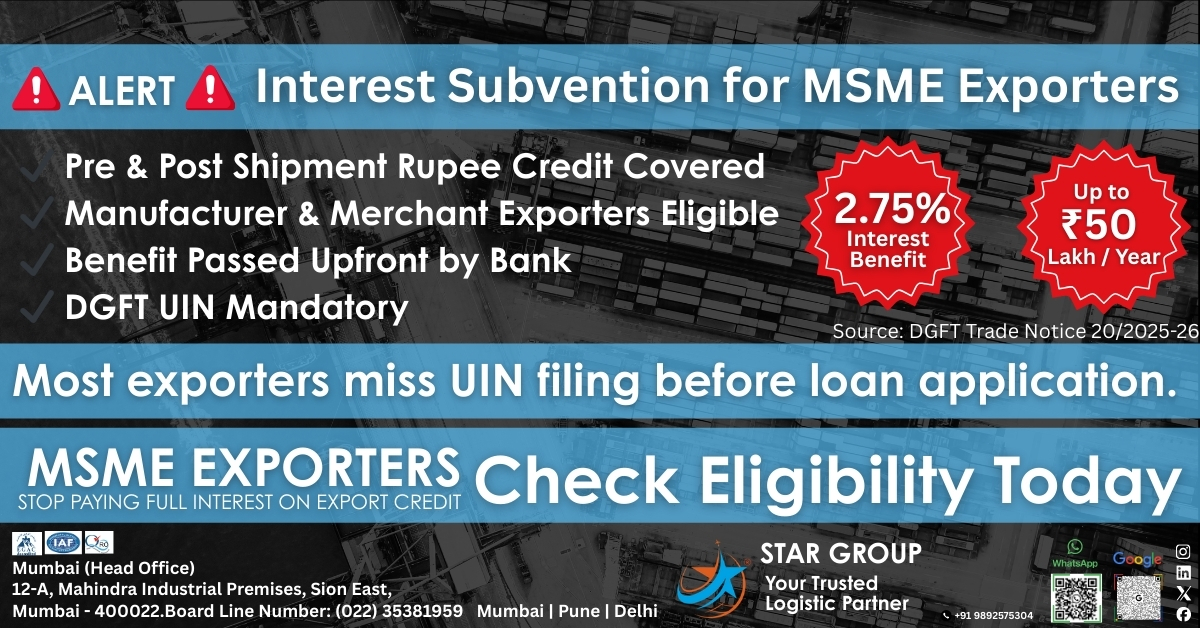
Interest Subvention for MSME Exporters (DGFT – EPM Niryat Prothsahan): What Small Exporters Need to Know (Trade Notice No. 20/2025-26, dated 02 Jan 2026)

Interest Subvention for MSME Exporters (DGFT – EPM Niryat Prothsahan): What Small Exporters Need to Know (Trade Notice No. 20/2025-26, dated 02 Jan 2026)

March 04, 2026

OverviewDGFT has launched “Interest Subvention for Pre- and Post-Shipment Export Credit” under the Export Promotion Mission (EPM) – Niryat Prothsahan through Trade Notice No. 20/2025-26 dated 02 January 2026, with immediate effect. The intervention is ope...

Import Duty Payment Just Got Easier: CBIC Extends Deferred Payment to 30 Days (Effective Feb 2026)

Import Duty Payment Just Got Easier: CBIC Extends Deferred Payment to 30 Days (Effective Feb 2026)

March 12, 2026

Do you know that the Government of India now allows eligible importers to pay customs duty after 30 days instead of paying it upfront?In a major relief for compliant importers and domestic manufacturers, the Central Board of Indirect Taxes and Customs (CB...

Eligible Manufacturer Importer (EMI) Scheme: Why This Customs Update Matters for Manufacturer-Importers

Eligible Manufacturer Importer (EMI) Scheme: Why This Customs Update Matters for Manufacturer-Importers

May 15, 2026

The Central Board of Indirect Taxes and Customs (CBIC) has introduced an important facilitation measure for eligible manufacturer-importers through the Eligible Manufacturer Importer (EMI) Scheme. Under this framework, approved EMI entities can clear impo...

Transition Facilitation (Quality Control) Order, 2026: What Businesses Should Know

Transition Facilitation (Quality Control) Order, 2026: What Businesses Should Know

June 30, 2026

The Ministry of Commerce and Industry, through the Department for Promotion of Industry and Internal Trade (DPIIT), has notified the Transition Facilitation (Quality Control) Order, 2026.This notification is important for businesses dealing with selected ...

EDPMS & IDPMS Reconciliation: How Exporters and Importers Can Clear Pending Entries

EDPMS & IDPMS Reconciliation: How Exporters and Importers Can Clear Pending Entries

August 05, 2026

An export payment may have been received—or an import payment completed—yet the related Shipping Bill or Bill of Entry may still appear as outstanding in the banking system.These pending records can arise from missing documents, incorrect references, diff...

Certificate of Origin (CoO): A Complete Guide Meaning, Types, Rules, Process and Documents

Certificate of Origin (CoO): A Complete Guide Meaning, Types, Rules, Process and Documents

August 05, 2026

In international trade, the country from which goods are shipped is not always their country of origin.A product may be exported from India, contain inputs sourced from several countries and still qualify—or fail to qualify—as Indian-origin, depending on ...

India–Oman CEPA TRQ 2026–27: Eligible Products, In-Quota Duty Rates and Application Guide

India–Oman CEPA TRQ 2026–27: Eligible Products, In-Quota Duty Rates and Application Guide

August 05, 2026

The Directorate General of Foreign Trade (DGFT) has invited applications for Tariff Rate Quota (TRQ) allocation under the India–Oman Comprehensive Economic Partnership Agreement (CEPA) for FY 2026–27.Applications can be submitted from 4 August 2026 to 19 ...

Download Broucher

Get a Quick Quote
for Your Import-Export & Logistics Needs